
BOOK REVIEWS: The Underground Man of Fyodor Dostoyevsky
The paradoxical character of Dostoyevsky’s “anti-hero” highlights those subversive elements of human psychology that resonate increasingly with our contemporary understanding. It is the plight of the modern individual, who is mired in an unending quest for truth and identity, and while confronting an ever-shifting sense of reality. Dostoyevsky, however, distances himself from his underground protagonist at the novel’s beginning and reappears only at its conclusion, thus intending to present the character as merely a framing device. This type of narration engages the reader in a dialogue to the extent that there is no opinion for which he does not predict and then pursue.
Dostoyevsky brilliantly plays with the ‘ideas’ as well as the ‘ideologies’ pertaining to the question of human desire, happiness, self-consciousness, the urban condition, and the isolation of modern man – encompassing the underground identity. These ideas are then projected onto the persona, who, possessed of himself, is drawn into a dramatic collision with the contemporary theories of his ideological opponents. At the same time, Dostoyevsky also contradicts, in regards to individuality and self-affirmation, with a self-defeating performance; deeming himself a ‘spiteful’ and ‘sick’ human being who desires to become an insect as a way to be rid of the perceptions paralyzing him with inaction. The only thing consistent in such paradoxical tirades is a morbid self-awareness and the futility of his calculations.
Dostoyevsky has driven himself into isolation, leaving behind the society he despises and yet longs to be a part of. Therefore, this underground man is encountered as he reaches an apparent impasse, finding consolation in the belief he is unaccomplished due to his intelligence; a fact which likens his fate to no more than ‘a mouse under the floorboards.’ Later, the novella will evolve into a memoir of the experiences that led him to the state of disillusionment, and which readers may find mirrors realistically the moment when the novel was published.
As Dostoyevsky builds his case for individuality and personal freedom against the social utopias of nineteenth-century Europe, he questions the logic of pre-defined laws of happiness as given by the socialists, concluding that both the ‘laws of consciousness’ and the ‘laws of nature’ were insufficient to provide the answers to man’s self-destructive existence.
Dostoyevsky’s unique concepts regarding ‘ideas’ and ‘feelings’ are rendered into a single entity, which becomes the constitution of his characters, defining their identity and human condition. Notes from Underground is structured around such an edifice and presented by the protagonist in the first half, so that the ‘feelings’ and experiences establish the foundational element of those ‘ideas.’
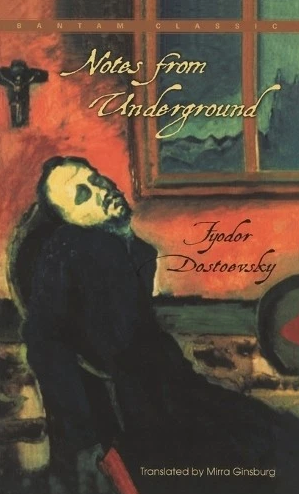
The paradox of the underground man, however, lies in the cyclical possibility that the very ideas themselves have been the cause of the human experience. This is demonstrated as the author finds refuge tracing the roots of his pain within the crucial memories of youth, recalling an incident when he, tormented by self-loathing and in desperate need of human contact, decides to join a party of his old schoolmates at a hotel; a situation in which he has deliberately invited humiliation, and for the reason of sheer boredom, along with the desire to avenge his assumed failures. Dostoyevsky’s skillful contemplation of this ‘scandal,’ his favorite dramatic device, becomes a tool the underground man uses to break through the prison of isolation.
As Dostoyevsky has watched himself through recollections, we find an intricate depiction of the dark recesses of human psychology and the comic irony of agency, which often works against human desires:
“[…] at last, the confrontation with reality.”
It is here in the text when dejection and humiliation are central to the narrative of Notes from Underground, as in most of Dostoyevsky’s works. During these final scenes, the underground man’s tearful, confused, and troubling conversation with twenty-year-old Lizza (who, out of vanity, he encourages to leave her abject position, only to refuse to redeem her later on) is a painful and stark realization of human psychology.
As the curtain is drawn on this unsettling performance of the human condition, Dostoyevsky intervenes as the implied author and remarks that nothing could have stopped or prevented this miserable man from tormenting and humiliating himself further, since “we,” the logical and scientific humans, have ourselves, lost the courage to live and feel.
Written by: Sidra Ali Shah